
Clarity
Clarity refers to the diamond's tiny markings. Any marks or "inclusions" in a stone subtract from its clarity, and therefore, the value and perceived beauty.
When looking to buy diamonds, you may hear the terms like Flawless, VVS1 or VVS2, VS1 or VS2, and SI1 or SI2.
These terms refer to the grading scale that is used when determining the clarity of a diamond.
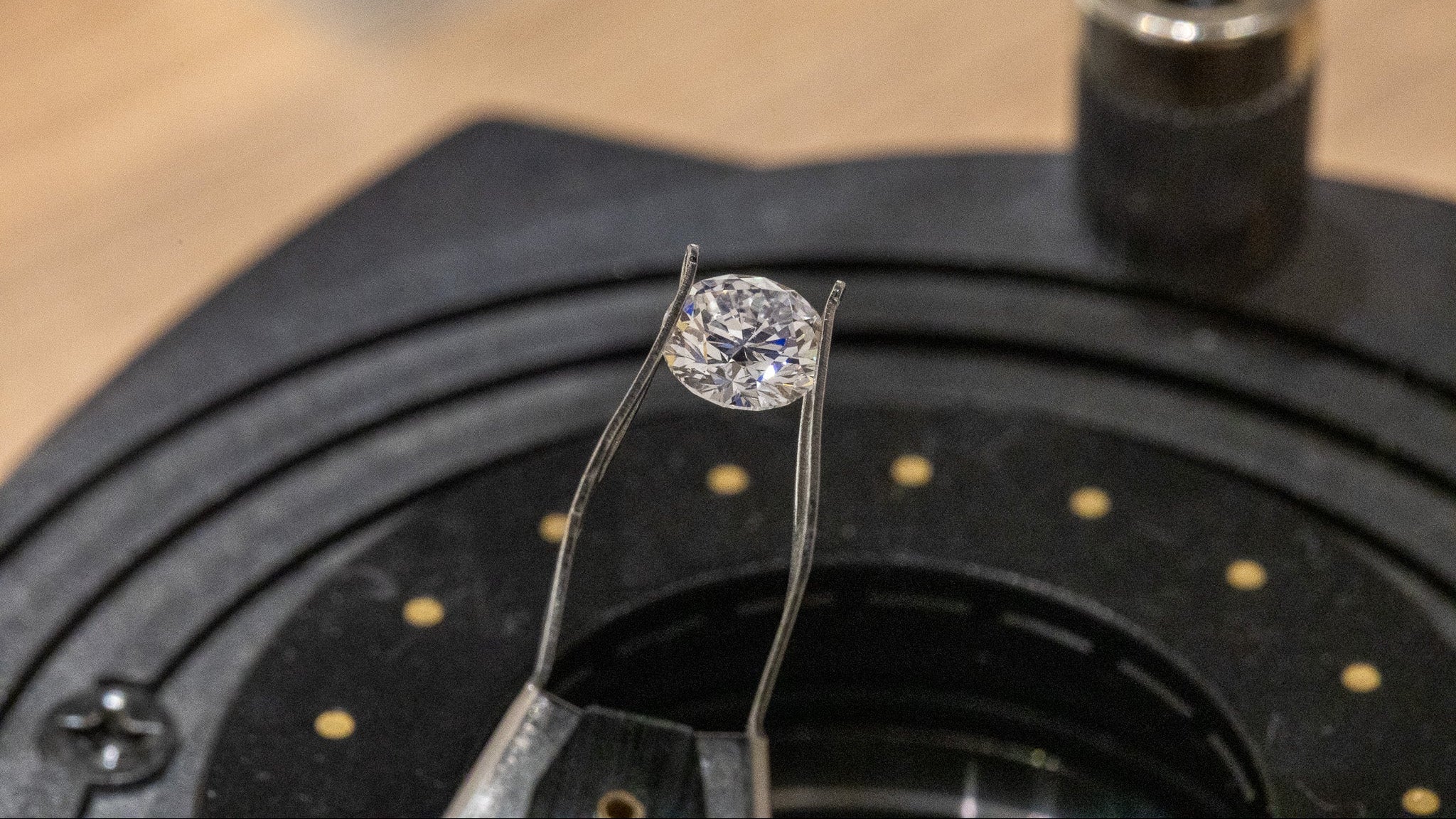
A flawless diamond has no visible flaws under a 10X microscope. These diamonds are incredibly rare since all diamonds have some imperfections due to how diamonds are formed.
Next, there are VVS1 and VVS2; these terms refer to diamonds that have very tiny inclusions that are difficult to see under a 10X microscope. A VVS1 is slightly better than a VVS2.
After VVS1 and VVS2, there is VS1 and VS2, diamonds with this rating, still, only have minor inclusions that you cannot see without 10X magnification. Similar to VVS1 and VVS2, VS1 has fewer inclusions than VS2.
SI1 and SI2 refers to diamonds that have more noticeable inclusions at 10x magnification, with some having inclusions that are visible to a keen eye without magnification. The difference between S1 and S2 is the location of the inclusions, with SI2 usually being visible from the pavilion, the lower portion of the stone, and the top.
Finally, I1, I2, and I3 are all considered included diamonds that have inclusions that are visible to the eye.
TIP: When looking to buy a diamond, always ensure you view your diamond under a 10X Gemscope, so you can make an informed choice.
Did you know shape impacts clarity? A round, princess, oval, marquis, pear and heart-shaped diamond naturally hide many inclusions because they are cut with a multifaceted pattern, which reflects light from different angles. For these shapes, colour, carat or cut could be prioritized.
In contrast, emerald and asscher-shaped diamonds are cut to emphasize transparency, which can make imperfections more visible. For these shapes, it is important to prioritize higher clarity.