
Round or oval engagement ring: a comparison without rules about your hands
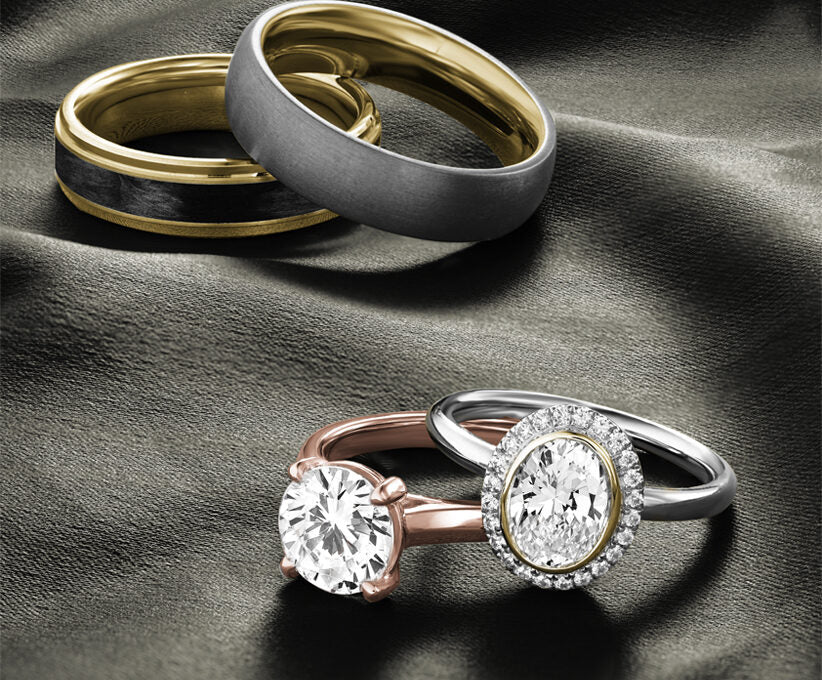
You do not need a rule about finger shape to choose between a round and an oval outline. Try both on the hand that will wear the ring and decide which appearance you enjoy.
Keep the initial comparison simple. Look at similar setting styles so the outline is the main feature changing. Notice the ring from your own viewpoint and at normal conversation distance, not only in a close-up photo.
Within the oval options, compare the actual proportions instead of assuming every oval looks the same. Ask for the dimensions and view the individual stone. Within either shape, evaluate the documented characteristics and appearance of the specific diamond rather than relying on shape alone.
Then introduce the setting details and wedding band you prefer. Your favourite outline in isolation may look different once the full ring combination is considered.
If you keep switching preferences, describe the reason each appeals. One may feel familiar while the other gives you a longer outline. That is a useful design conversation, not evidence that you are choosing incorrectly.
Choosing a pointed diamond shape: questions about the setting
If you like pear, marquise or other pointed outlines, include protection of the vulnerable areas in your setting discussion. Diamonds can chip from impact, and GIA notes the importance of protecting points and corners. Read GIA's diamond care guidance.
Ask the jeweller to show how the exact setting supports and protects the stone. Do not judge the design only by how little metal is visible in a top-view photograph. The setting needs to be assessed with the individual stone.
Try the ring in the orientation you prefer and view it beside a possible wedding band. Notice the overall outline on your hand and ask whether the pairing creates any contact that needs attention.
Before purchasing, request care advice for that design and learn which changes should prompt an inspection. Avoid home tests or attempts to adjust a setting yourself.
A pointed outline can be a personal style preference without being a reason to skip practical questions. The aim is to understand the ring you choose and the care it requires, not to expect any diamond to be indestructible.
High or low engagement ring setting: use the side view
The side view helps you understand how an engagement ring sits on the hand. Compare the actual designs rather than assuming that “high” or “low” describes every practical difference.
Try the rings and look at the space beneath the centre setting. Ask how the height relates to the design and whether it affects the wedding band combinations you can consider. If wearing a straight band closely beside it matters, test that specific pairing.
Think about your clothing and daily habits. Describe concerns about gloves or catching details, then ask the jeweller to assess the shortlisted settings. No profile should be treated as a promise that a ring will never snag or need care.
Take a side photograph, with permission, for each finalist. A folder containing only top views can hide the feature you are actually trying to compare.
Choose the profile you enjoy with a clear understanding of its practical implications. A lower appearance is not automatically the right answer, and a more elevated setting is not automatically a problem. The assessment belongs to the exact ring and the wearer.
Choosing a ring from photos: make a better inspiration board
A useful inspiration board explains your taste. It should help a jeweller understand what you like, not leave them to guess which part of twenty different rings caught your attention.
Limit the first board to five images. Under each, complete the sentence “I like this because…” Use concrete observations: a stone outline, plain shoulders, a colour contrast or a particular side detail. Add one image showing something you want to avoid.
Separate fixed preferences from experiments. Label a must-have clearly, but leave room to discover that a different design feels better on your hand. Include the budget and intended completion date outside the image collection so practical requirements stay visible.
Do not assume every photographed detail can be combined into one ring. Ask a jeweller to evaluate the construction and explain what would change if you brought several ideas together.
Keep links or source names with the references. The board is a communication tool, not a request to copy another creator's exact design.
After the appointment, revise the board using what you learned from actual rings. It should become smaller and clearer as the decision progresses.
Explore engagement rings with Appelt's and compare the shapes without a predetermined answer.
Related collections: Round, Oval, Pear, Marquise.
At Appelt's
Appelt's carries round and oval engagement rings from designers such as Simon G., Gabriel & Co. and Noam Carver, so you can try both shapes on your own hand in one visit. On eligible full-priced rings the Rock Solid Diamond Warranty covers the centre stone up to 2.5 carats, with limits set out in the published terms.
Appelt's Diamonds has been family owned in Manitoba since 1938, with four stores: three in Winnipeg and one in Morden. Each store has a goldsmith on site. Appelt's holds the CJA Multi-Store Retailer of the Year award, and eligible purchases are covered by the Rock Solid Diamond Warranty. You can see all four locations or start with engagement rings in Winnipeg.